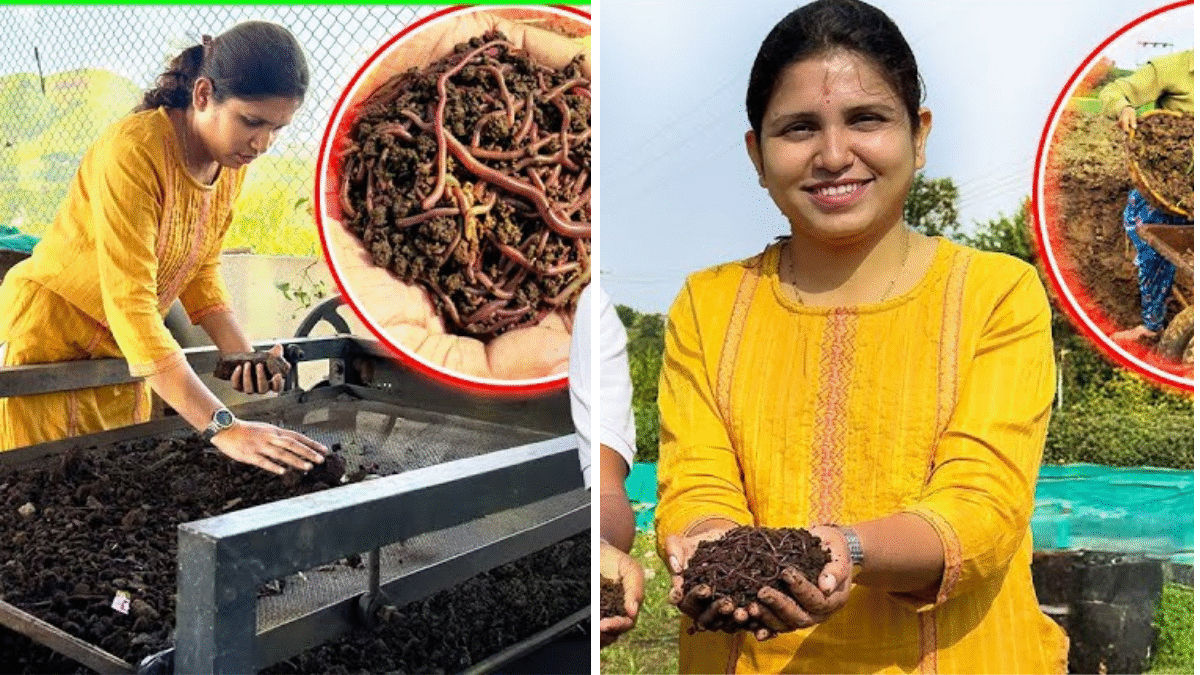
Kavya, a trained nurse from Mumbai, never imagined that her life would eventually revolve around soil, earthworms, and farmers instead of hospital wards. Educated as a nurse, Kavya worked in a government nursing job, serving first at Sion Hospital and later at Tata Cancer Hospital, where she spent nearly five years treating critically ill patients. The work was stable, respected, and emotionally demanding—but it also exposed her to the deeper roots of illness.
Watching patients suffer made her question the quality of food people consume and the chemicals entering the human body through agriculture. During the COVID-19 lockdown, when she stayed in her native village Manikdoh in Junnar taluka, Maharashtra, she began observing farming closely. That period changed her life.
Within two years, Kavya resigned from her government job, returned permanently to the village, and built a one-acre vermicompost enterprise with an annual turnover of Rs 24 lakh, now aiming for Rs 50 lakh, proving that farming—done scientifically—can be both meaningful and profitable.
Understanding Soil: The Foundation of Farming
Most farmers believe they do all the work in farming. But in reality, nearly 99% of the work is done by microorganisms in the soil. Farmers only support this system.
Excessive use of chemical fertilizers and pesticides kills these microorganisms. Productivity may look high in the short term, but soil life keeps declining. That is where organic inputs like vermicompost become critical.
Vermicompost is not just manure—it is a living system that restores soil biology, improves structure, increases nutrient availability, and supports residue-free farming.

Starting Small: One Bed, One Step
The journey did not begin with big investment or large land. It started with:
- A very small shed
- Just one vermicompost bed
- Local materials like bricks, plastic sheets, and cow dung
- Indigenous earthworms
Instead of rushing to build 100 beds, learning was done step by step. One bed became ten, ten became forty. Mistakes were made, observations were written down, and improvements were continuously implemented.
This approach is the biggest lesson for farmers: don’t start big, start smart.
Low-Cost Vermicompost Model
The vermicompost system developed here is farmer-friendly and low-cost:
- Brick-lined beds (long-lasting and reusable)
- Plastic sheet base to avoid soil mixing
- Fresh desi cow dung (not fully decomposed)
- Proper moisture, shade, and ventilation
- Limited water, no electricity, no heavy machinery
Earthworms don’t need light. They need:
- Controlled moisture
- Good ventilation
- Organic matter at the right decomposition stage
With proper management, one bed gives 700–800 kg of vermicompost in 50–60 days, along with multiplied earthworm culture.

Production, Profit, and Practical Numbers
Currently:
- Around 40 beds are operational
- Capacity is 100 beds
- About 40 tons of vermicompost is produced in two months
At an average selling price of ₹10 per kg:
- ₹4 lakh revenue in two months from compost
- Around ₹2 lakh net profit
Additionally:
- 200–300 kg of earthworm culture sold monthly
- Extra income of ₹80,000–90,000 per month
- Almost zero additional cost, as worms multiply naturally
Last year’s total turnover crossed ₹24 lakh.
The current year’s target is ₹50 lakh—all while living in the village.
Why Vermicompost Has Unlimited Scope
One acre of farmland needs at least one ton of vermicompost. Even if every farmer produces compost, demand will still exceed supply.
This means:

- No fear of competition
- No fear of “business leakage”
- More farmers = healthier soil + stronger agriculture
The real goal is not monopoly, but self-reliant farmers and residue-free farming.
Training Farmers, Not Just Selling Product
A major step was starting a training center. Many people visited, but not everyone implemented what they saw. So structured training was introduced:
- Cow dung selection
- Bed preparation
- Earthworm lifecycle
- Harvesting cycles (30, 45, 60 days)
- Sieving, storage, packaging
- Most importantly: marketing
Till now, 19+ batches have been completed, with 30–50 farmers per batch. Training is mainly for farmers, not urban hobbyists, because villages need this knowledge the most.
Marketing: The Missing Link for Farmers
Many farmers know how to produce, but not how to sell. The biggest myth is: “You produce, someone else will sell.” That doesn’t work.
Here, marketing was built through:
- Direct farmer connections
- Social media and YouTube
- Showing real work, not fake success
- Sharing struggles, processes, and results
Trust became the brand. And trust created the market.

Village vs City: Where Is Real Satisfaction?
When asked whether city jobs paid more or village farming does—the answer was instant:
“Here, 100% satisfaction.”
Income is important, but ownership, freedom, and peace of mind matter more. In farming, you are not an employee—you are the owner.
Message for Youth and Women
Today’s youth want quick results. But farming teaches patience.
Three things are essential:
- Build your own system
- Create your market
- Stay patient and grounded
Farming is a natural business. It doesn’t collapse overnight. It grows slowly, but strongly.
For women especially, this story proves that agriculture is not limited by gender. Knowledge, consistency, and courage matter more than physical strength.
Conclusion: The Soil Still Has Power
This is not just a success story—it is a reminder.
A reminder that villages still have opportunities.
That soil still has life.
That farming can provide income, dignity, and purpose.

If one woman can leave a city job, return to her village, build a vermicompost model, train hundreds of farmers, and aim for a 50-lakh turnover—then every farmer has potential.

Leave A Comment